

Humans have always been fascinated with rainbows, yet these days it seems AI rainbows are uniquely alluring. Rainbows lead to that magical pot of gold, right? Even as an adult, I can’t help but see a rainbow and muse over treasure at the end. It is one of those stories that can get so ingrained in a culture, that it almost runs as a subroutine in our brains.
Like when your palm itches and you think about money. Or you hesitate and walk around a ladder instead of under it. The way you might flinch when cracking a mirror. Seven years of bad luck.
While these might be silly superstitions, we’d be naive to believe we’re immune from their influence…or the childlike hope of easy treasure.
We have been down this path before many times with different rainbows: the internet, websites, social media, Facebook fan pages, self-publishing, etc. We’re not immune to the lure of easy treasure…and right now, the shiniest rainbow is labeled “AI”.
The “AI Rainbows” Distraction

Might as well begin with pointing out the ugly truth. To be really excellent at any skill, one has to suffer. We humans, deep down, don’t respect what took nothing to learn, create, or do.
It reminds me of a debate I was having with Spawn (teenage son) about the movie The Matrix. All of us were wowed at the superhuman feats one could “learn” in that movie with just a flash drive plugged into your HEAD. Need to know Kung Fu? Don’t have a couple decades to haul water up the stairs to some monastery while the master hits you with sticks?
No problem. Let’s just give this a download….
I extended the logic with Spawn, though. While this idea of “instant skill” might be novel and exciting initially, what it steals is far more insidious. What if tomorrow, I could download how to play masterful piano? Who really would want to listen to me play? Or come to a concert? Buy my music? Seems to me they’d all be busy pushing their own new and shiny skills in similar fashion.
For a while.
Then it would all feel hollow, empty, cheap, and a lot like…cheating.
How long would I stick to playing piano? What takes nothing to “master” also takes nothing to “dismiss.” How quickly would I grow bored with my new and “perfect” piano skills?
***The same skills everyone else with that “piano mastery brain download” have, too.
It took me years of reading, writing, learning, practicing, sacrificing and showing up day after day even when I didn’t feel like it to hone my skills. Yes, AI can outline faster, organize faster, can even WRITE FOR ME! But why would I do that? Unused muscles either never develop or, if developed, will atrophy from disuse.
The AI rainbow is alluring but so were the sirens’ songs, and where, exactly was that song leading those sailors?
AI Rainbows & Fool’s Gold Fallacy

I have personally witnessed a MASSIVE shift in the quality of writing in the past ten years. With all the digital tools rainbows we have, the easy access to research, spell check, and grammar check, one should expect overall quality to improve. Yet, we are seeing the opposite. Unwatchable movies, unreadable books, soulless art, music without that human spark.
Do we need to mention the McDonald’s Christmas commercial that used ONLY AI? Yes, yes we do.
I’ll admit the Digital Age has been to blame for feeding this monster, especially once social media became such a cornerstone for relevance and market advantage. The relentless demand for more content, fresh content, relevant content to “captivate” audiences has chained many creatives to Hell’s Treadmill.
Companies are falling for this as well, which is why they’re leaning far too heavily on AI. AI can be controlled, monitored and writers become interchangeable pieces on a Monopoly board. Easy to plug in, duplicate and keep on a leash. Same for all creatives. Writers are picky, actors are divas, and artists are moody. Most inconveniently?
They expect to actually be PAID for what they do.
*clutching pearls*
Thus, in another staggering move to “increase profits” and “save money” companies are increasingly outsourcing to AI generated content. Content that is supposed to be bold, edgy, creative, compelling…and just happens to look, sound and feel just as “unique” as all the other “unique” content.
When everyone is special, then no one is, which was the point we explored in the last post, Counterfeit Creativity: The High Cost of Cheap Art.
Writers Who Know How to MINE

Mining is a mixture of skill, courage, tenacity, wisdom, and flat out insanity. It is a lot of tedium, toil, work, and thankless pain. Writing, like mining for anything, requires patience, endurance, innovation, and passion. But, last I checked, those weren’t for SALE.
Yet, what do we know about all “gold rushes”? Who gets rich? The ones wielding shovels or those selling shovels? Prospectors rarely struck it rich. Winners sold to the miners. BIG WINNERS (snakes) sold to those who liked the idea of being rich more than the work involved.
Whether it was reselling spent plots, phony maps, or sure-fire tricks to STRIKE IT RICH, it didn’t matter. There was always a naive/gullible market ready to throw their own gold down to skip the hard parts…and a snake to take their money.
It’s human nature.
Fast-forward to today, and AI companies, prompt gurus, “millionaire author” courses, content mills, “authentic human author” certifications. They’re the shovel-sellers. They profit off the rush without digging themselves.
But here’s where the metaphor flips in our favor. In every gold rush, a few stubborn diggers hit pay dirt. Over time, tests and failures, they eventually became experts at terrain and geology. Skilled prospectors learned invaluable tells that could lead to larger, richer strikes.
They learned to spot “tells” (signs in the geology/terrain like quartz veins, color changes in soil, or river bends that trap gold). Writers—masterful writers—do something similar. We notice the patterns, the trauma, the unevenness and how that all guides the way to the REAL story.
In my opinion, AI’s fixation on “perfect” is one of the biggest flaws in the system. Humans are messy, ugly, irrational, emotional, unpredictable and illogical, which—ironically—are all the ingredients of AMAZING WRITING!
AI is the CZ of our time. Flawless! Perfect! But still just a fancy piece of glass.
All Writers Should Be Wary of AI Rainbows
We have seen this play out time and time again. Whenever we invent a tool to make something better, faster, cheaper, easier, there is always, always a cost. We have film students in COLLEGE who cannot sit through a full-length movie, writers who never read, and Amazon and the internet is drowning us in AI slop.
Why?
Again, humans will always choose novelty and the path of least resistance (at least for a while).
Did spellcheck make a generation of better spellers? Nope. It masked errors so well that many never internalized rules—kids lean on it, brains skip the muscle-building, and we end up with adults who can’t spell.
Did grammar check transform us all into a society that understood the complexities of sentence structure and subject-verb agreement? Hardly. It fixes surface stuff on the fly, but deep grammar knowledge? The knowledge that allows a writer to wield grammar as another tool is something only a LOT of reading, studying and practice can train.
POV is an incredible tool. Why choose first-person, or third or even second? What emotional effect are we going for? In Caroline Kepnes’ You, she selected second-person POV which is almost never used…ever. Yet, when placed in a story told from the stalker’s perspective? Chilling.
T. Jefferson Parker broke with tradition and told the antagonist’s POV through first-person and Charlie Hood’s (the investigator) in third. Why? Because Jeff wanted the reader to bond emotionally with the antagonist to demonstrate the emotional complexity of the topic. There is no clean black and white and good and bad. Just messy, flawed humans doing the best the can when the deck is stacked against them.
That’s the magic AI can’t replicate. It can spit out “correct” prose, but it can’t feel the weight of those choices. It can’t draw from lived chaos to make a story resonate. The cost of chasing “perfect” shortcuts? We lose the very mess that makes writing human—and worth reading.
Keep Those Mining Skills Sharp
Tools in and of themselves can only do so much. Slight tangent but makes my point. I used to LOVE watching home improvement shows that demonstrated ways to decorate for super cheap. Initially, I was mesmerized. They did ALL THAT for under $1000! Then I realized it was a thousand dollars in supplies.
That money didn’t cover the saws, drills, guns, welds OR the SKILL to use any of those. When one hires a contractor, we aren’t hiring the table saw, rather the artisan who can use that saw masterfully. I mean I can use a table saw. Can watch a video. Most have guards that will mostly keep my fingers in tact…but I have zero skills.
I am far more likely to make a mess massacre than a masterpiece.
Same in writing.
While AI rainbows are pretty, what they lead to? Not all that glitters is gold.
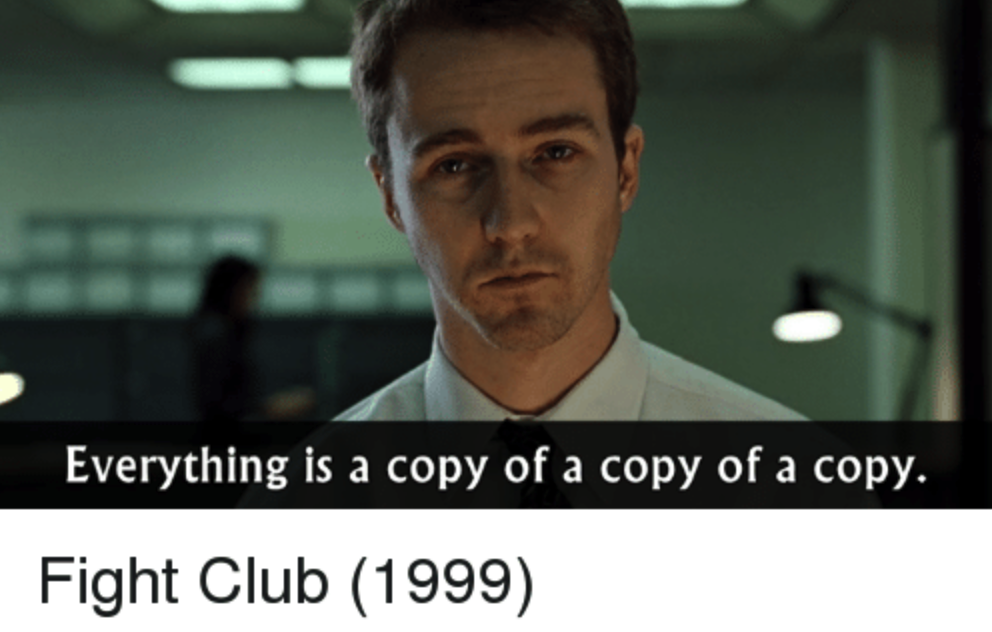
Right now? I feel we are living this meme from Fight Club. Everything is a copy of a copy of a copy. Remember, earlier I stated that humans initially love novelty and convenience? That love wears thin super quick and the shine is already dimming.
There are no shortcuts and we’d all be wise to just leave the AI rainbows where they belong…on Lisa Frank Trapper Keepers.
What are YOUR Thoughts on AI Rainbows?
I know today is St. Patrick’s and we all want a bit of luck, but luck alone has never been enough without the skills to take advantage of opportunity.
How do you feel about what AI is doing to us skill-wise? Are new writers failing to mature and dig deeper because of the quick thrill of “perfectly packaged prose”? If they are “training” on recycled content, how valuable is the training? Are the younger generations of content creators driven by a desire to create meaningful art and expression or the need for a quick dopamine fix?
Is AI unwittingly eroding the very character traits necessary for great artists (Eg. tenacity)?
For writers who have been here more than a minute, are you concerned that your skills will erode? Do you find yourself constantly second-guessing skills you’ve used for years? Or does that compel you to train even harder to stand apart from the crowd?
For a profession that seems to UNIQUELY SUFFER from Imposter Syndrome, do you think AI only makes this feeling worse? It was bad when everyone assumed every published author was self-published, but at least they didn’t think a ROBOT wrote it. How does this make you feel? The shift of bad writing must be human and good writing must be AI.
I’d like your thoughts!



26 comments
Skip to comment form
What’s amazing is how poorly AI writes. 3 descriptions in ever chapter, the same verbage. It’s ridiculous. I, however, will admit to using AI for my grammar and spelling. But I also hire two editors to ensure what is there is correct.
Author
I can definitely spot AI “voice.” A lot of turns of phrase that were odd a year ago but you see everywhere now. Like, “Chef’s kiss!” Does anyone in real life actually use that regularly? I do notice a lot of the same patterns and it’s what is making everything beige.
Personally, I like using AI for blogging in really ONE WAY. I run the post through for typos and grammar. My eyes are usually so tired I can miss extra spaces, homophones, or maybe I was tweaking a sentence and muddied it up. Saves making my eyes bleed trying to spot those picky bits.
I will ask it to prompt for ideas, but that is to get my brain warmed up and I usually choose something along a vector that is my own. I have spent many, many years training my brain to be able to organize thoughts quickly and cleverly and that is a skill that will wither in a hot minute if you let it.
My wife and I disagree over AI. Since her stroke (fortunately minor) she finds that using AI to rework her emails stops people calling her “blunt” so much. I can see that she feels it helps, because she can’t change her style (brain issues). But, aside from the fact that AI produces bland and generic work that will only get MORE bland (as it feeds on its own output) , it’s an environmental disaster, it teaches nothing, and there’s no path to profit for the companies involved, so it will collapse. I can’t see the attraction of it at all. Set it to work on useful things it CAN do better than people – pattern recognition in medicine and astronomy.
I’m with you 100%, Damian. As a scifi writer of a certain vintage, I’m used to thinking of AI as a powerful tool, so what I’m seeing now is ridiculous. The Tech Bros will never get to AGI for a variety of reasons, including simple biology, and the ponzi scheme under which everything is funded. The collapse is inevitable. The Chinese, on the other hand, are using their AI as the tool it was meant to be. And then there is the issue that simply hasn’t been addressed – theft. Humans can be punished for copyright theft, but AI [Tech Bros] can’t? We really have lost our way. 🙁
YES! The theft! Technology built on stolen work, and we should just accept it because it would have been “too expensive” to do it legally?
Author
Oh I will ALSO be writing on THAT.
As a professional editor, I’ve seen a ton of changes over the years. The past couple of years (before AI), the vast majority of writers I was getting were retired people who “always wanted to write a book.” The books were really awful, both fiction and nonfiction. It was frustrating because the writers didn’t want to learn how to fix their writing, they just wanted me to do it all. But even when I edited a book as best as I could, it was still terrible.
Now I’m getting cringy books from non-writers (painful enough) that was “polished” by AI, and it’s even worse! Overly fancy language is mixed in with the writer’s clunky wording, POVs are all over the place, and nothing is cohesive. I already have in my contract that I won’t edit AI-generated writing, but now I have to clarify that I won’t edit writing that used any wording from AI.
It’s sad to hate doing what I once loved. Now I only edit books from writers I know personally who don’t use AI. I’ve switched to teaching editing courses for new editors and workshops for writing and editing conferences. I also write books–and don’t use any AI, of course. But I often wonder if writing and editing will no longer be careers in the near future. It doesn’t look that way.
I learned a long time ago that writing can’t be taught, it can only be learned. How does that happen? It happens by reading everything you can in your genre and writing every day till it becomes a habit. And remembering that your readers are a gift and your agents are your clients. Attitude plays a big part in success as a writer. Always a great read and advice from Kristen Lamb, my first and biggestinspiration in the writing industry. So grateful to know her.??
Yup. Kristen’s a treasure AI could never approximate.
Author
Awww, thank you (((HUGS)))
I’m testing AI to see if it can help me set up successful Amazon ads. It’s algorithms, pattern recognition, and hard data, nothing creative. AI’s incapable of creativity. Hell, you have to remind it that a hand has five fingers, which way an arm is supposed to bend, how many hands a person should have, etc. whenever you give it image creation prompts *shudder*.
AS a Data Center Tech, I get to see the face of AI every day I work: servers, racks, graphics cards, cooling systems, and fiber cables everywhere. AI is technology, a tool. It doesn’t think or feel. It’s never had nor ever will have human experience. It’s incapable of an original thought or concept, yet far too many people interpret the calculated responses as creative, original, or even real. It’s just math with humans sometimes accomplishing good things, but far too often making messes.
I wish Amazon would run each ms through every AI chat thing for signs of “books” being a generated response and ban those from their sites. But no, such wish is only an idealistic daydream.
Still, I wonder if this digital snake will devour its own tail in the literary world as the craving for a real human connection grows ravenous. Heck, maybe this is how traditional publishing makes a comeback. We publish only human-made prose!
I dunno. I don’t have a crystal ball, and I’m abysmal at predicting the future. Kristen, haaaalp.
Author
Actually THAT is a GREAT way for authors to use AI. For the creative part? There is no reason to outsource our SUPER POWER.
Broken record syndrome here, I commented on your last post that I used AI for a chapter critique. I was stunned at the improvements over earlier AI versions, both the praise and criticisms, which I agreed with and made changes. But without that human connection, writing/critique groups or seeking professional feedback, you’re not going to learn to write prose that real live people want to read. Unless you’re some kind of fiction writing savant and I doubt any of us replying to Kristen’s post fit that description.
I know you think you can spot it. I think I can spot it, too, but I’ve been lurking in groups where writers are learning how to use AI to write an entire book with the press of a button, edit its own writing, and then remove its AI-isms. It is scary. When I’m reading a book in bed at night, if I come across a certain make of car or a name that is on the AI list of cars or first/last names that it uses constantly, I start to wonder. Is this? Like all of you here, I don’t want to read computer lit.
Author
And I HATE that! Because it makes everyone suspicious of creatives. The frigging EM DASH is a great example. Go look through my posts. I have almost 20 years of articles on-line and you can see I LOVE the em dash…but so does AI. Now, every time someone sees an EM DASH, they roll their eyes and go, “Must be AI” OR they are at least suspicious.
We have enough BS that rips people out of the fictive dream without this nonsense.
I hate AI. It robs us of our humanity but it can be useful. I need spell check because I learned to read at age 4, which means I’m a site reader, which means I don’t know phonics or the weird rules of English spelling. I can’t sound out a word I never read before even though I read unusually fast and retain it. If Spell check is AI, I am guilty of consorting with the enemy. If not for love/hate relationships we might be less human…or not?
Assistive AI can be helpful. It’s just like asking someone nearby, “How do you spell thorough?” Or looking up a word in the dictionary. I learned at two to recognize words by sight as well, especially since I have synesthesia. I can typically tell if a word is spelled right because of the “colors” in it. The main problem with AI is that people ask it to write something, quote it, and don’t use their own imagination to write. That’s Generative AI. It generates all the text (or art or music) and people put their name on it.
Author
I use AI to check for typos, grammar glitches, etc. I think that is a great use for AI (and yes, spellcheck and Grammarly and all that count as AI).
I love this article. You said what I’ve been thinking but was not able to articulate well. There are groups where authors are learning to use a process of putting in a codex (AI generated outline, with characters “fleshed out”) and letting AI write. Presto: 70,000 words in a couple hours.
What’s the point? I ask. OK, I know. Money, duh. Churn out the genre fiction, overwhelm with volume, make a decent living. But what I meant by “what’s the point?” is what you were talking about in your brilliant post. They’re no longer writers. They are, at best, producers of soulless, terrible-to-mediocre books. I recently read Sue Monk Kidd’s Writing Creativity and Soul. An inspiring work about how hard it can be to write, and how rewarding. These AI book producers are not writers, and they’ll never understand what it means to reach deep down and use your own human experience to create something unique.
On the other side, the readers. I think… if they find an “author” they like, who is putting up an entire series every month of five books or releasing books every other day, I think they have to know what they’re getting. And if they enjoy it, the way some people will eat overly sweet, chalky, all but tasteless chocolate, then I say, let them enjoy these books. But these readers will never find a spark of creative brilliance in these books because that’s not what these book producers are even trying for. The rest of us will continue to enjoy smooth, creamy chocolate with depth and different flavor notes, and search for writers with something to say. That’s my hope, anyway. Trying to be positive in an industry I’ve been in all my adult life from non-fiction researcher to editor to writer.
I’m training harder. Currently, I’m deep into a developmental editor course, and I’ve already completed copyeditor courses because I don’t want to rely on AI. Using my noodle helps keep it young and quick, and I like learning. I’m also concerned about it taking over writing jobs, editing jobs, jobs in all fields, and people need to earn a living. Additionally, I’ve had my indie books scraped and stolen. It is theft. So, yes, it is disturbing witnessing the swell of AI use, and I don’t have a crystal ball (wish I did!). Maybe the bubble people speak of will burst, and maybe not. We shall see!
I used AI at work. I started a new job after being laid off from my old job after 27 years, and I didn’t trust my marketing writing skills. They were pretty rusty. I found that AI was a good tool for giving me ideas. It would spit out options, and I’d take those options and make them my own. Gradually, I gained my confidence and skills back, and now I rarely use AI. I did find that I felt guilty, and even more of an imposter. When I stopped using AI, that feeling went away, too.
I did find that it helped me with plot ideas, but I’m careful to make the plot my own. If I lived next door to Kristen Lamb, I’d just come over, sit around the table and plot a novel in an hour. Really… who needs AI when you have Kristen1
Author
GURL! If you lived next door we’d get nothing done, LOL! Or we would just have the most AWESOME writing group…ever! Yeah I use it for that and, as you know, I will feed work through to look for typos, grammar, repetitive words and any obvious problems…but I FIX THOSE.
And thanks for the confidence boost. I was worried no one really wanted to hear anything more about AI.
AI in the writing context is evil. It has revolutionized many aspects of our lives–medicine, the military, transportation–but witting isn’t one of them. With any luck someone will come up with a bad ass way to spot and discard writing developed through AI. Excellent article, and I am glad someone folks are sounding the alarm before we can’t put the genie back in the bottle (to use a non-AI cliche.)
Real writers! Yes! You nailed it! REAL WRITERS MARKET
Wow. That was incredibly well said! I agree completely. I can take it even further. I have a library science degree and worked as a librarian for a while in a major metropolitan library system (before discovering I’m not cut out to answer the same exact question 27 times a day). I became a librarian just as computers were becoming commonplace and the internet was beginning to be a thing, so I’ve seen the way we gather information change dramatically, and while it’s made life easier, I wouldn’t say it’s better. When I was in college and grad school then library school, we had to dig and mine for information — we had to LEARN how to find things out. We couldn’t just google anything: we had to figure out the most likely terms to search — first the card catalog, then databases — and each source would lead us to more sources. Because of that we learned all kinds of things along the way. They may not have been directly relevant to what we were searching for, but they provided context and added to the sum of our knowledge, which made us more rounded human beings and better citizens of the world. Also, for information to be preserved in a library or database, that almost always meant it had been vetted by other experts, ensuring it was factual and accurate. With the internet, we don’t even have to spell something correctly for a search engine to come back with the answer, and it takes us right where we want to go. We lose out on learning anything but the exact answer we were looking for.
Ironically, ChatGPT once flattered me with this description of my librarian-learned skills: “Librarians aren’t trained to be walking encyclopedias—they’re trained to be reliable navigators of uncertainty. That’s a very different skill. A good librarian isn’t the person who has all the answers; they’re the person who knows how to find the best answer, evaluate it, and recognize when the available information is incomplete or contradictory.”
We don’t evaluate information anymore. And as AI continues to learn, it’s going to get harder and harder to distinguish computer-generated from real. That’s just going to speed up the dumbing-down of humanity.
Author
Yeah, I will be writing new material on this soon. Have had some predictions of my own I was waiting to see play out. Thanks for the thoughtful comment!